Session 2.1 – Verification & Validation Overview
Module 2: Verification & Validation | Duration: 1 hour
Learning Objectives
- Differentiate verification vs validation within the V-Model.
- Identify activities, roles, and artifacts mapped to life-cycle phases.
- Explain how V&V reduces delivery risk and builds confidence.
Overview
Verification and validation are a dual safety net. Verification activities ask, “Did we implement the specification correctly?” Validation activities ask, “Is the product we built the one the user actually needs?” Keeping the two perspectives visible throughout the SDLC prevents expensive late-stage surprises.
Review findings, static-analysis reports, checklist sign-offs, documented waivers.
User feedback, scenario results, pilot metrics, go/no-go recommendations.
Reduced rework, clear accountability, auditable evidence for regulators and stakeholders.
V-Model Mapping
The V-model illustrates how every development activity has a mirrored test activity. Planning verification and validation along the left “specification” side ensures the right tests are ready when the implementation on the right side is available.
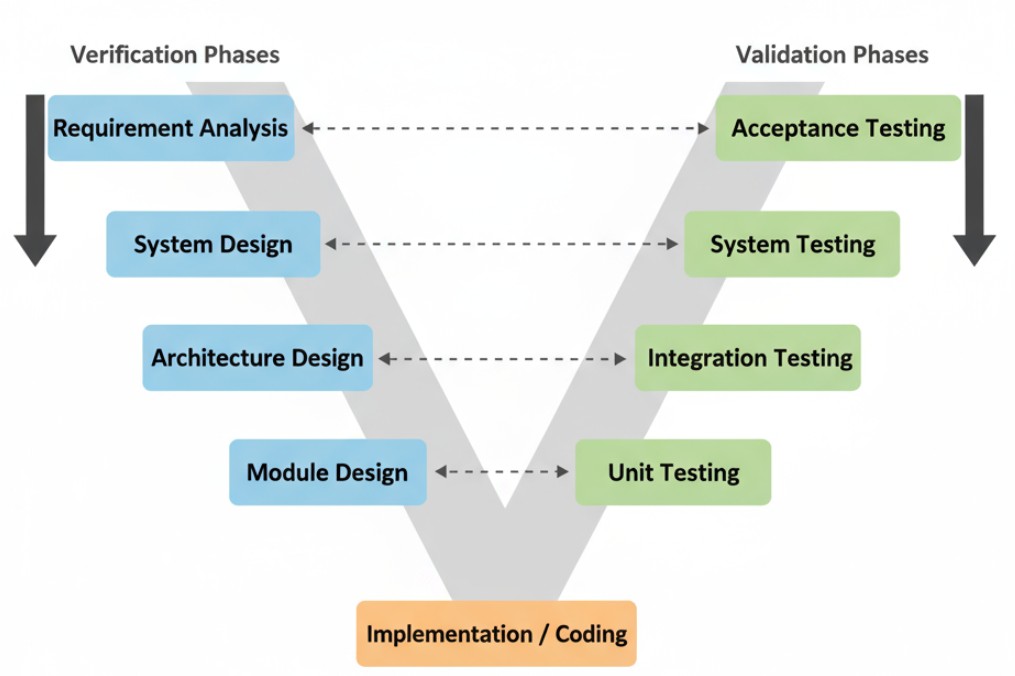
- Verification gate: Requirements review complete before acceptance test design begins.
- Validation gate: Acceptance scenarios approved before first release candidate.
Lifecycle Activities
| SDLC Phase | Verification Focus | Validation Focus | Evidence Produced |
|---|---|---|---|
| Requirements | Stakeholder review, ambiguity busting, traceability seeds | Personas, prototypes, story mapping workshops | Approved BRD, acceptance criteria, UX notes |
| Architecture / Design | Architecture board, threat modeling, interface contracts | Concept validation, PoCs for risky stacks | Design review minutes, risk register updates |
| Implementation | Code reviews, static analysis, unit coverage | Scenario test design, data prep, exploratory charters | Pull-request sign-offs, automated test suites |
| Release & Ops | Deployment checklists, regression dashboards | UAT, canary/blue-green, observability alerts | Go/No-Go notes, runbooks, SLO dashboards |
Artifacts & Roles
Test strategy, review checklists, static-analysis reports, traceability matrix, waiver log.
Scenario catalog, data design, environment readiness, UAT scripts, pilot reports.
Architects & dev leads own verification evidence; product owners, SMEs, and customer champions own validation sign-offs.
Summary & Assignment
Every SDLC phase deserves a matching verification and validation activity. Planning them together shortens feedback loops, exposes risks early, and makes release decisions evidence-driven.